Table of Contents
If you’re a parent battling bath time resistance, you’ve probably searched for a solution that doesn’t involve screens, complex setups, or constant battery changes. The promise of simple, wind-up bath toys that swim on their own is alluring. As a product analyst and a parent who’s tested more bath toys than I can count, I was skeptical. Could three plastic turtles really transform the nightly routine? I put the SEPHIX Wind Up Bath Turtle Toys through rigorous, real-life testing with a 14-month-old to find out.
Key Takeaways
- Simplicity is their superpower: The wind-up mechanism requires no batteries, making them instantly ready for fun and eliminating a common point of failure.
- Durability is above average: Made from solid ABS plastic, these turtles can withstand being dropped, chewed on, and thrown across the bathroom far better than many rubber or squeeze toys.
- Engagement has limits: While fantastic for initial distraction and water introduction, they won’t hold a toddler’s attention for a full 20-minute bath on their own.
- Not completely submersible: A key trade-off is that they float and swim on the surface; they don’t dive or operate underwater, which may disappoint some kids.
Quick Verdict
Best for: Parents of 12-24 month-olds looking for a simple, durable, and battery-free toy to ease bath time anxiety and encourage initial water interaction.
Not ideal for: Older toddlers (3+) seeking complex play, or parents who want toys that can be fully submerged or squirt water.
Core Strengths: The non-toxic ABS plastic construction is robust and easy to clean. The wind-up action is reliably fun and teaches a simple cause-and-effect relationship.
Core Weaknesses: The play pattern is one-dimensional. They only swim on the surface, and the novelty can wear off after a few minutes for easily bored children.
Product Overview & Specifications
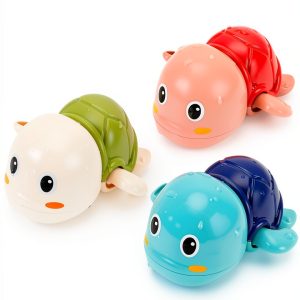
The SEPHIX bath turtle set consists of three brightly colored tortoises (green, blue, pink) made from a single piece of molded ABS plastic. There are no stickers, decals, or small parts that can detach. The key feature is the wind-up key on the underside—a few twists store kinetic energy, which is released when you place the turtle in water, causing its flippers to paddle and propel it forward.
| Specification | Detail |
|---|---|
| Material | Non-toxic ABS Plastic |
| Age Recommendation | 12 months and up |
| Pack Contents | 3 x Wind-up Turtle Toys |
| Product Dimensions | 3 x 4 x 2 inches (each) |
| Item Weight | 5.9 ounces (total) |
| Power Source | Wind-up (No Batteries) |
| Key Features | Swimming action, smooth edges, colorful design |
Real-World Performance & Feature Analysis
Design & Build Quality
Out of the box, the first thing you notice is the weight. These feel substantial, not like flimsy, hollow plastic. The ABS plastic is smooth with fully rounded edges—I ran my fingers over every seam and found no sharp spots. This is crucial for a toy destined for the hands (and mouth) of a 12-month-old. The colors are vibrant and opaque, not painted on, so there’s no risk of them chipping or fading into the bathwater. Compared to the cheap, rubber ducky-style toys that often develop mold inside, the solid, one-piece construction of the SEPHIX turtles is a significant win for hygiene and longevity.
Performance in Real Use
This is where theory meets the splashy reality of a toddler’s bath. The wind-up mechanism is straightforward: you turn the key until it resists. In testing, a full wind provided about 10-15 seconds of continuous swimming. The motion is a direct, slightly frantic paddle that sends the turtle zipping in a straight line. It’s genuinely entertaining the first few times.
Real-Life Scenario 1: The Distraction Technique. My 14-month-old used to cry when water was poured over her head to rinse shampoo. Introducing the blue turtle changed the game. While one parent would start winding it up, she’d be captivated, watching intently. The moment it started swimming, her focus was entirely on chasing it, making the rinse-off process dramatically easier. The toy served as a perfect, 15-second distraction.
Real-Life Scenario 2: The Cause-and-Effect Lesson. After a week, my toddler began to understand the connection. She’d try to turn the key herself (a fine motor skill challenge) and would giggle uncontrollably when she successfully placed it in the water and saw it move. This interactive element is a key benefit over passive floating toys.
The Trade-Off: The major limitation is that they are surface swimmers. They will not dive or operate underwater. If your child is hoping for a submersible toy, this isn’t it. The play pattern is also repetitive. After the fifth consecutive bath, the initial “wow” factor diminishes, and it becomes one tool in the bath-time arsenal rather than the main event.
Ease of Use & Supervision
From a parent’s perspective, these are incredibly low-maintenance. No batteries to buy or replace. A quick rinse and air dry is all the cleaning required. The wind-up key is large enough for an adult to handle easily but can be a challenge for a very young toddler, meaning they will often need your help to activate it. This isn’t necessarily a bad thing, as it promotes interaction, but it does mean you can’t just hand them over and walk away. Active supervision is still required.
Durability & Reliability
After three weeks of near-daily use, including being dropped on tile floors and gnawed on during teething moments, the turtles show no signs of wear. The plastic hasn’t cracked, and the wind-up mechanism remains as smooth as day one. The true test of durability for any wind-up toy is the spring mechanism inside, and so far, it has proven robust. This is a clear advantage over battery-operated toys, where corrosion from water exposure is a constant threat.

Pros & Cons
Pros:
- No Batteries, No Hassle: The wind-up feature is reliable and eliminates ongoing costs and environmental waste.
- Exceptionally Durable: The solid ABS plastic construction can withstand rough toddler handling.
- Easy to Clean & Hygienic: No holes or internal chambers means zero risk of hidden mold growth.
- Promotes Interaction: Teaches simple cause-and-effect and can be a shared activity between parent and child.
- Safe for Young Babies: Smooth edges, non-toxic material, and no small parts make it suitable from 12 months.
Cons:
- Limited Play Scope: They only swim on the surface, which can become repetitive for older toddlers.
- Novelty Can Wear Off: They may not hold a child’s attention for an entire bath session after the first few uses.
- Requires Adult Assistance: Most children under 2 will need help winding the key effectively.
- Not a Squirt Toy: They don’t hold or squirt water, which is a feature many toddlers enjoy.
Comparison & Alternatives
To understand the SEPHIX turtles’ place in the market, it’s essential to compare them to other types of bath toys.
Cheaper Alternative: Generic Rubber Ducks/Boat Set
- Price: ~$4-6 for a multi-pack.
- Value Difference: You get more toys for less money, but they are typically made from softer, less durable rubber or PVC that can puncture and develop mold inside. They are passive floaters with no mechanical action.
- When to Choose: If you’re on an extremely tight budget or need a large quantity of disposable toys for a party. The SEPHIX turtles offer superior durability and interactive play for a marginally higher price.
Premium Alternative: Munchkin Float and Play Bubbles
- Price: ~$15-20.
- Value Difference: This battery-operated set features rings that light up and make bubbling sounds when pressed underwater. The play is more sensory and engaging for a longer period.
- When to Choose: If your child is easily bored (18 months+) and you want a toy with multiple functions (lights, sounds, submersion). The trade-off is battery dependency, higher cost, and more complex parts that can potentially fail.
Buying Guide / Who Should Buy
Making the right choice depends entirely on your child’s age, temperament, and your own priorities as a parent.
Best For Beginners (Ages 12-18 months): If you are introducing your baby to bath time or trying to overcome a fear of water, these turtles are nearly perfect. The simple, predictable swimming action is mesmerizing at this stage and provides a fantastic distraction. The safety and durability are ideal for this age group.
Best For Value-Seeking Parents: If you want a toy that will last through one child and potentially be passed down, the robust construction of the SEPHIX turtles makes them a smart investment. You avoid the recurring cost and hassle of batteries.
Not Recommended For:
- Parents of older toddlers (3+ years): Children at this stage often crave more complex play, like squirting, pouring, or construction. The one-dimensional nature of these toys will likely lead to them being ignored.
- Those seeking a “set-and-forget” toy: If you want to plop a toy in the bath and let your child play completely independently, look elsewhere. The need for winding means it requires active participation.
- Anyone wanting underwater play: If your child loves dunking toys and watching them sink or dive, these are not the right choice, as they are designed solely for surface swimming.
FAQ
Q: Are these SEPHIX bath turtle toys truly safe for a 12-month-old who still puts everything in their mouth?
A: Yes, based on their construction. They are made from non-toxic ABS plastic, which is the same material used in many high-quality building blocks. There are no small parts that can come loose, and the smooth, rounded edges pose no cutting or choking hazard. Always supervise your child during play.
Q: How long do the turtles swim on one wind?
A: With a full wind (turning the key until it stops), you can expect about 10-15 seconds of swimming. This is long enough to be exciting but short enough that the child will want to do it again, creating a cycle of engagement.
Q: My bath toys always get moldy inside. Is that a risk with these?
A> This is a major advantage of the SEPHIX turtles. Because they are made from a single, solid piece of plastic with no holes, valves, or internal chambers, water cannot get trapped inside. This completely eliminates the risk of hidden mold growth, a common problem with squeeze toys and some rubber ducks.
Q: Is the SEPHIX 3-pack worth the price compared to other bath toys?
A> If your primary needs are durability, safety, and simple, interactive fun for a young toddler, then yes, absolutely. You are paying for a quality, long-lasting product rather than a disposable one. If you need a toy that will entertain a preschooler for 30 minutes or you prefer squirting/water-pouring toys, then your money is better spent elsewhere.